Logmarketplace-files-vs-generator
A DXF file bought on Etsy or a parametric generator: what changes for a 3D ACM cassette
On marketplaces, a cassette is sold as a fixed file: one size, one thickness, one machine. What that costs the workshop, and what a generator does instead.
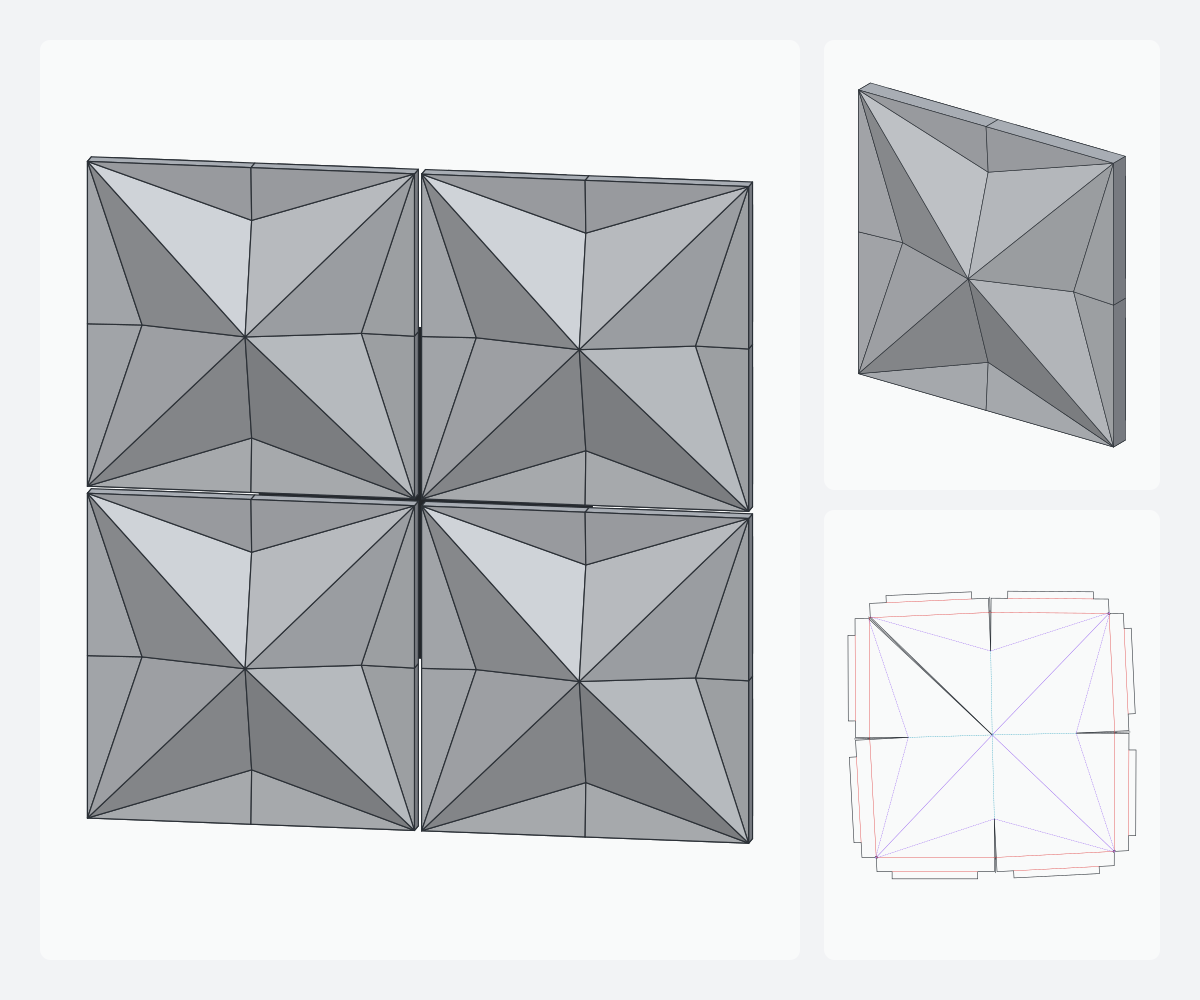
Type “DXF façade cassette” on Etsy or another digital-file marketplace and you will find 3D panel patterns sold for a few euros each, ready to download. For a decorative panel cut flat, that is often enough. For an aluminium composite façade cassette, grooved and folded, a fixed file causes problems you only discover at the machine.
A fixed file is one size, one thickness, one machine
The file you buy was drawn for one specific cassette: 600 × 600 mm, say, in 4 mm, with its author’s cutter. Your architect has drawn a layout in 580 × 1,150. The temptation is to scale the DXF in the CAM software. That is exactly what you must not do.
- Returns and tabs must keep their real depth: scaled to 190 %, 40 mm returns become 76 mm and no longer fit the substructure.
- The width of a V-groove depends on the thickness and the cutter angle, not on the panel size: scaled, it becomes wrong.
- The bend deduction depends on your material and your machine. The file carries its author’s, when it accounts for it at all.
- Apex slits and corner reliefs are computed on the final geometry: stretched, they no longer close the relief.
The result: you redraw by hand, or you lose a sheet to find the gap. On a façade of two hundred cassettes in three sizes, the few-euro file becomes the most expensive part of the job.
What the generator does instead
ACM 3D Studio does not sell a file: it recomputes the pattern at every setting. You pick one of the 28 families, then set what your project requires.
- Dimensions from 100 to 3,000 mm, relief height, returns, tabs and drillings: the unfolding stays correct by construction.
- The composite thickness and your machine profile: every groove goes on its cutter’s layer, with its exact width.
- Your workshop’s bend deduction, measured once on the supplied test coupon: the developed length is corrected to a tenth of a millimetre.
- The finish: RAL colours, anodised, copper, corten, seen in a realistic render, as a full wall and in augmented reality on the real façade.
- Sheet nesting and the cut sheet: the number of sheets and the waste rate before you order the material.
And the engine checks before exporting: overlapping faces, a drilling inside a groove, tabs colliding at assembly. A bought file says none of this; it goes to the machine as it is.
When a fixed file is enough
For a one-off part cut flat — a sign, a decorative screen, a panel with no fold — a bought file does the job very well. The difference shows as soon as there are folds, several sizes, an imposed thickness or a client who wants to see the façade before signing.
Read also: why we wrote this generator, or open the four-notch star cassette in the studio right away.