Façade cassettespro
Chevron cassette
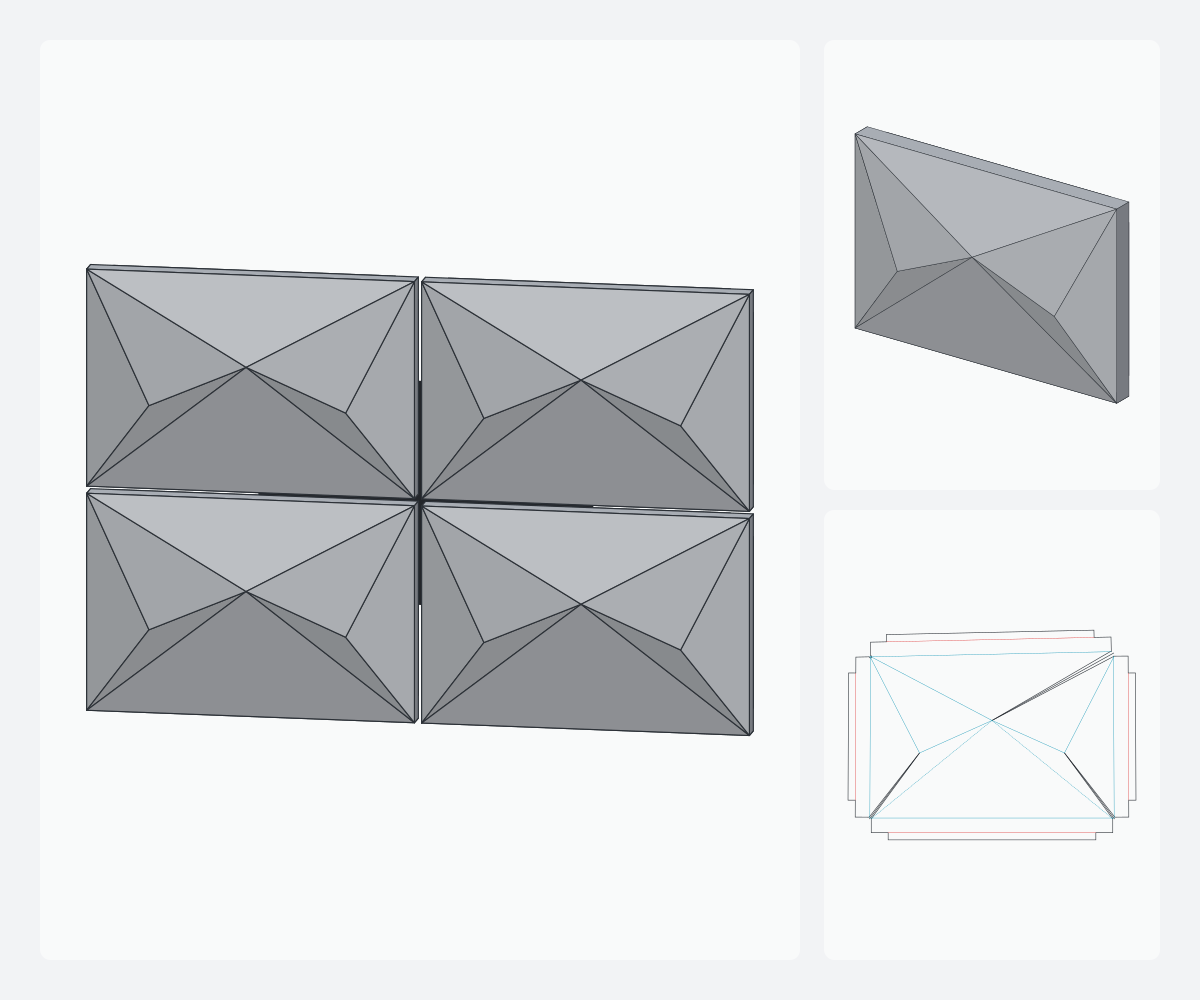
A V-shaped broken ridge: two ridge ends and an offset central point, at adjustable height. Free ridge length and chevron offset; laid in turned rows, the pattern becomes a continuous zigzag.
Open in the studio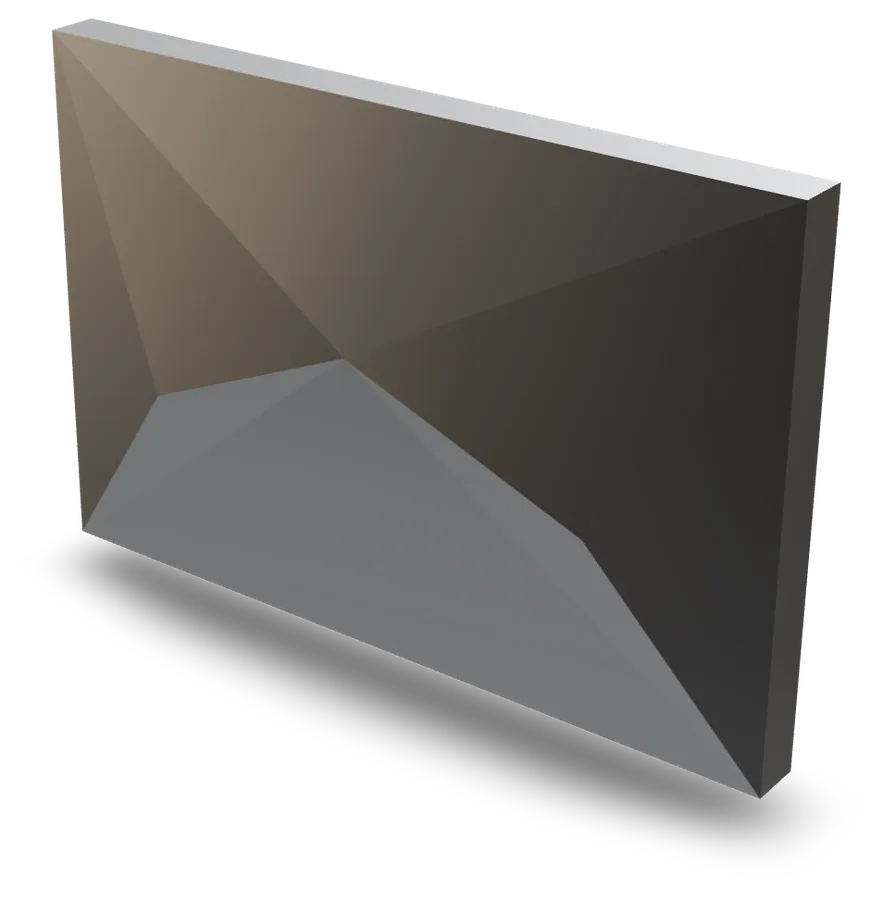
ACM 3D Studio
- Developed
- 715.4 × 521 mm
- Material
- ACM 4 mm
- Folds
- 15
- Mark
- chevron
Fabrication data
Chevron cassette — at 600 × 400 mm in 4 mm ACM, this family unfolds into a 715.4 × 521 mm flat pattern with 15 folds, including 774 mm of groove machined from the visible face, with the sheet flipped for that pass. A 1,500 × 3,200 mm sheet holds 12 of them, for 13.8 % waste.
- Material per panel
- 0.345 m²
- Folds
- 15
- Total groove length
- 5,724 mm
- Cutting length
- 4,687 mm
- Corner slits
- 3
- Corner reliefs
- 3
V-grooves (apex angle)
- 90°1,664 mm
- 74.6°803 mm
- 3.3°774 mm
- 79.4°607 mm
- 74.3°598 mm
- 10.6°541 mm
- …
Panels per sheet
- 1,220 × 2,440 mm6(30.5 % waste)
- 1,500 × 3,200 mm12(13.8 % waste)
DXF layers
- CONTOUR4,687 mm
- RAINURE_1002,008 mm
- RAINURE_901,664 mm
- RAINURE_1601,278 mm
- RAINURE_AVANT_160front face774 mm
The names and colours your CAM software will show. RAINURE_AVANT: fold concave on the visible face, sheet flipped for that pass.
Computed by the engine at the default parameters, on 4 mm ACM and the reference router. Your own machine and material profiles change these values in the studio.
Parameters
| Parameters | Range | Default |
|---|---|---|
| Width | 200 – 3,000 mm | 600 mm |
| Height | 200 – 3,000 mm | 400 mm |
| Relief height | 5 – 150 mm | 45 mm |
| Ridge length | 20 – 90 % | 60 % |
| Chevron offset | -300 – 300 mm | 80 mm |
| Ridge end drop | 3 – 60 mm | 12 mm |
| Return depth | 0 – 200 mm | 40 mm |
| Fixing tabs | — | ✓ |
| Tab width | 10 – 60 mm | 20 mm |
PresetsChevron pointing upChevron pointing down, long ridge
Manufacturing constraints
- The return must exceed the groove width plus half the bend deduction, or the groove eats into the return.
- Facet-to-facet folds are grooved with the smallest cutter of the profile, V left open: the angle is held by the geometry. The angle between two facets must not exceed that cutter’s apex angle.
- Vertical returns, all tabs flat in the −D plane (rail mounting). The facet-to-return fold is 90° ± slope: below 90°, the 90° cutter is left open and the return is held by the riveted tab; above 90° (facet descending towards the edge), a wider cutter (60° nominal = 120° apex) or the machine profile’s overfold tolerance is needed.
- Every raised vertex requires a V-slit to the edge (a flat sheet has 360°, the relief less). Near the vertex the slit is narrower than the contour tool: it is cut along its axis and the tool bites each facet by up to Ø/2.
- Tabs are shortened at every corner and every kink of the edge so they never collide behind the panel: by (return + 2 mm), and more on a sharp corner, where the bisector must be cleared (tab width ÷ tan(angle/2)). An edge too short gets no tab.
- The offset is bounded by the ridge length (k < r·H / (2 − r), r = length / width): beyond, the ends would pass behind the point and the facets would flip.
- The ridge ends stay above the point–corners plane: a drop too large is brought back to its maximum (the ends would be saddles).
- The chevron offset is at least 10 mm in absolute value, otherwise the point merges with the ridge.