Guide 04 / 06 · 6 min read
Returns, fixing tabs and corner reliefs: the rules the generator applies
ACM 3D Studio · Published
Answer
On an ACM cassette, every tab is shortened by max(return, tab) + 2 mm at each end so it never hits the neighbouring tab behind the panel; a return must exceed the groove width plus half the deduction (9.2 mm on 4 mm with the defaults); and at every corner where two return grooves meet, the generator cuts each return on the other’s line and drills a relief of radius max(tool radius, deduction/2 + 0.5 mm), i.e. 3 mm with the Ø 6 tool. Families never draw these details: they are discovered from the pattern topology.
Return: the minimum depth
A return is the strip folded at 90° along an edge of the panel. Its groove has a surface width, and the fold axis moves r / 2 into the face with the deduction. The return must therefore exceed groove width + r / 2: on 4 mm ACM, 7.2 + 2.0 = 9.2 mm with the 90° cutter and the default deduction. Below that, the groove eats into the return and the engine emits GROOVE_TOO_DEEP with the value to enter. The flat cassette bounds the return between 15 and 200 mm; 40 mm by default.
On a relief cassette, an edge shorter than 20 mm stays free: too short for a return, the engine notes it. A depth of 0 removes all returns.
Tabs: the set-back
A fixing tab is folded 90° inwards at the end of the return, flat behind the panel. Two adjacent returns carry two tabs that meet in the corner: the neighbouring side’s tab comes in by its width T behind a return of depth D. Each tab therefore steps back from the larger of the two, plus a clearance:
s = max(D, T) + 2 mm          (set-back at each end)
tab length = L − 2 · s

default flat cassette: D = 40, T = 20 → s = 42 mm
   600 side → 516 mm tab; 400 side → 316 mm tab
A side shorter than 2 · s + 10 mm gets no tab (FEATURE_DROPPED says so). The free edge of the return is split into three segments and the tab only attaches to the central one. On relief cassettes, the same set-back applies at every corner of the base and every kink of the edge — the zigzag of a fan, the point where two facets of different slope meet — because the neighbouring returns are not coplanar there. At a smooth vertex (plain subdivision of a straight edge within the same facet), the set-back drops to 1 mm.
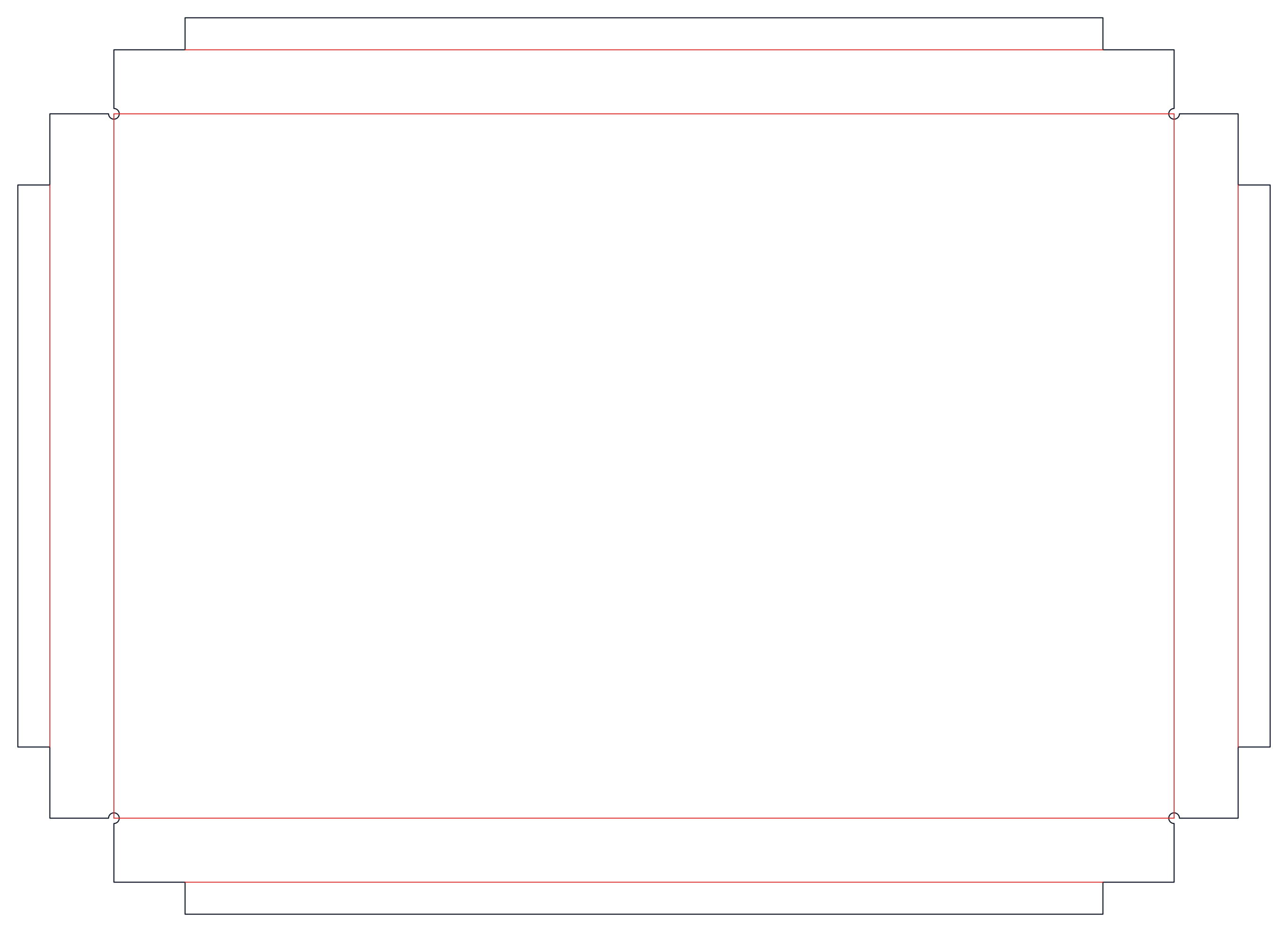
Corner reliefs: what the engine discovers
Families never generate reliefs. The engine looks in the theoretical pattern for corners where two grooves share an end point and does two things there:
- Bring the ends of both returns back. After deduction, each return overshoots the neighbouring fold line by
r / 2: as is, the two overlap in the pattern and collide once folded. At a square corner, each return is cut on the line of the other’s groove. Neighbouring facets that leave a tip beyond a return line are trimmed the same way. - Drill the relief at the intersection point: a hole of radius
max(tool radius, r / 2 + clearance). With theØ 6 mmcontour tool, the default4 mmdeduction and the0.5 mmclearance:max(3; 2.5) = 3 mm. It gives the material clearance at the fold, and a sharp inside corner cannot be milled.
Each return groove then stops at the foot of the corner point on its own line. When several facet folds converge on the corner (fan, star), the tips of non-adjacent facets overlap by a few mm²: the hole is enlarged to contain them, and its final size can be read in the metrics.
Three corner shapes
| Corner | When | Return cut | Relief |
|---|---|---|---|
| Square | returns within 30° of a right angle | each on the other’s line | 3 mm radius hole |
| Oblique | fan, star: grazing returns | on the bisector | hole + tool-centre cut along the bisector |
| Split | collinear grooves within 10° (V cassette, full-width ridge, diagonal band) | perpendicular to the edge at the midpoint of the two ends | hole + cut separating the two flaps |
At an oblique or split corner, the two returns cut on the same line would touch and close the hole: a tool-centre cut starts at the corner point along that line, crosses the return ends and exits the material by tool radius + 0.5 mm. It is an open polyline on CONTOUR, like a seam. The V cassette has two, one per split edge.
The machine profile chooses the relief shape: radiused (default, the classic dog-bone), mitre45 (both returns cut on the bisector, as on the catalogue’s reference patterns) or square — which does not really exist on a router: the square notch gets tool-radius fillets.
Two ends too close form one corner
A corner chamfered by a few millimetres separates two return grooves by an edge too short to carry a return. After deduction, each return moves r up towards its facet and the two collide if their ends are less than 2 r apart. The engine therefore merges end points closer than max(Ø tool, 2 r + clearance) = max(6; 8.5) = 8.5 mm into one corner. Same rule on both sides of a slit mouth.
Vertical returns on a sloped facet
On relief cassettes the returns are vertical (perpendicular to the wall) and all tabs sit in the −D plane, for rail mounting. The facet-to-return fold is 90° ± slope. Below 90°, the 90° cutter is left open and the return is held by the riveted tab. Above (facet descending towards the edge), it needs the 60° cutter (120° apex) or an overfold tolerance in the machine profile — 0° by default: the workshop decides.
What is checked before export
FACE_OVERLAP: two faces of the flat pattern overlap (beyond 0.01 mm²).ASSEMBLY_OVERLAP: two coplanar faces overlap once folded, at t = 1 — neighbouring tabs behind the panel, the only case the 2D test misses.DRILL_IN_GROOVE: a drilling bites a groove or leaves its trimmed face.
A pattern carrying any of these diagnostics is never exported. Open the flat cassette in the studio and push the tab to 60 mm on a 40 return to see the set-back go to 62 mm per end.
Read next: what the engine refuses to export, and why.
Frequently asked questions
- Why are the tabs shorter than the returns?
- Behind the panel, the neighbouring side’s tab comes in by its width T behind a return of depth D. Each tab therefore steps back by max(D, T) + 2 mm at each end. With the defaults (D = 40, T = 20), that is 42 mm per end: a 516 mm tab on a 600 mm side.
- What is the minimum return depth?
- Groove width plus half the deduction: 7.2 + 2.0 = 9.2 mm on 4 mm ACM with the default deduction. Below that, the fold groove eats into the return (GROOVE_TOO_DEEP). The flat cassette imposes a 15 mm minimum.
- What is the hole at the corners of the pattern?
- The corner relief. After deduction, each return overshoots the neighbouring fold line by r/2 and the two returns would collide once folded. The hole of radius max(tool radius, r/2 + 0.5 mm) gives the material clearance, and a sharp inside corner cannot be milled anyway.
- Can I get chamfered corners like on the reference patterns?
- Yes: the machine profile’s mitre45 mode cuts both returns on the bisector. The square mode gives a square notch with tool-radius fillets. The default is radiused.