Guide 01 / 06 · 5 min read
How to unfold a 3D ACM cassette (pyramid, slope) without wasting a sheet
ACM 3D Studio · Published
Answer
A 3D ACM cassette unfolds into a single sheet because every raised vertex gets a V-slit running to the edge: around an apex the facet angles add up to less than 360° (356.99° on the default diamond cassette) and the flat sheet has to lose that wedge of material. The generator triangulates the relief, keeps a spanning tree of folds, turns the remaining edges into seams cut along their axis, then checks the pattern flat and folded before exporting the DXF.
Why a pyramid cannot be unfolded without a slit
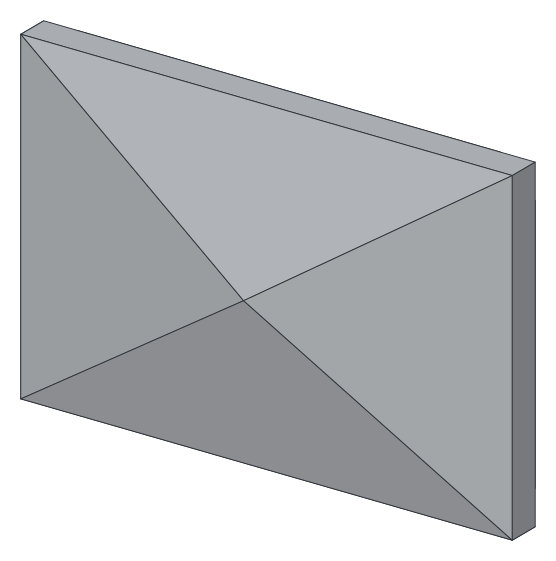
A raised apex is a vertex with positive curvature. Take the diamond cassette at its default values: 600 × 400 mm, centred apex, relief 40 mm. Around the apex the four triangular facets make angles that add up to 356.99°. A flat sheet offers 360°. The difference, 3.01°, is the angular defect: the material that has to go so the facets meet once folded.
defect(apex) = 360° − Σ facet angles at the vertex
= 360° − 356.99° = 3.01°   (diamond cassette 600 × 400, relief 40)
A positive defect requires a V-slit from the apex to the edge. A negative defect (saddle vertex) is refused: no flat sheet produces it, the pattern would overlap itself. A zero defect (flat ridge line, diagonal fold) needs nothing.
What the generator does: triangulation, spanning tree, seams
A relief family only provides its 3D mesh. Everything else is derived, once, by the same constructor:
- Each facet is projected to its 2D true shape (isometry of its plane). No face is ever curved: a rounded surface is faceted first.
- Each shared edge gets its signed dihedral angle: grooved from the back if positive, from the visible face if negative.
- A maximal spanning tree (Kruskal) picks the edges kept as folds. Interior edges weigh more than those touching the boundary: a short edge reaching the edge is cut by preference.
- A non-tree edge with an angular defect at one of its vertices becomes a seam (
Seam): two lips that only meet once the panel is folded. If the cycle is flat, it becomes a closing fold.
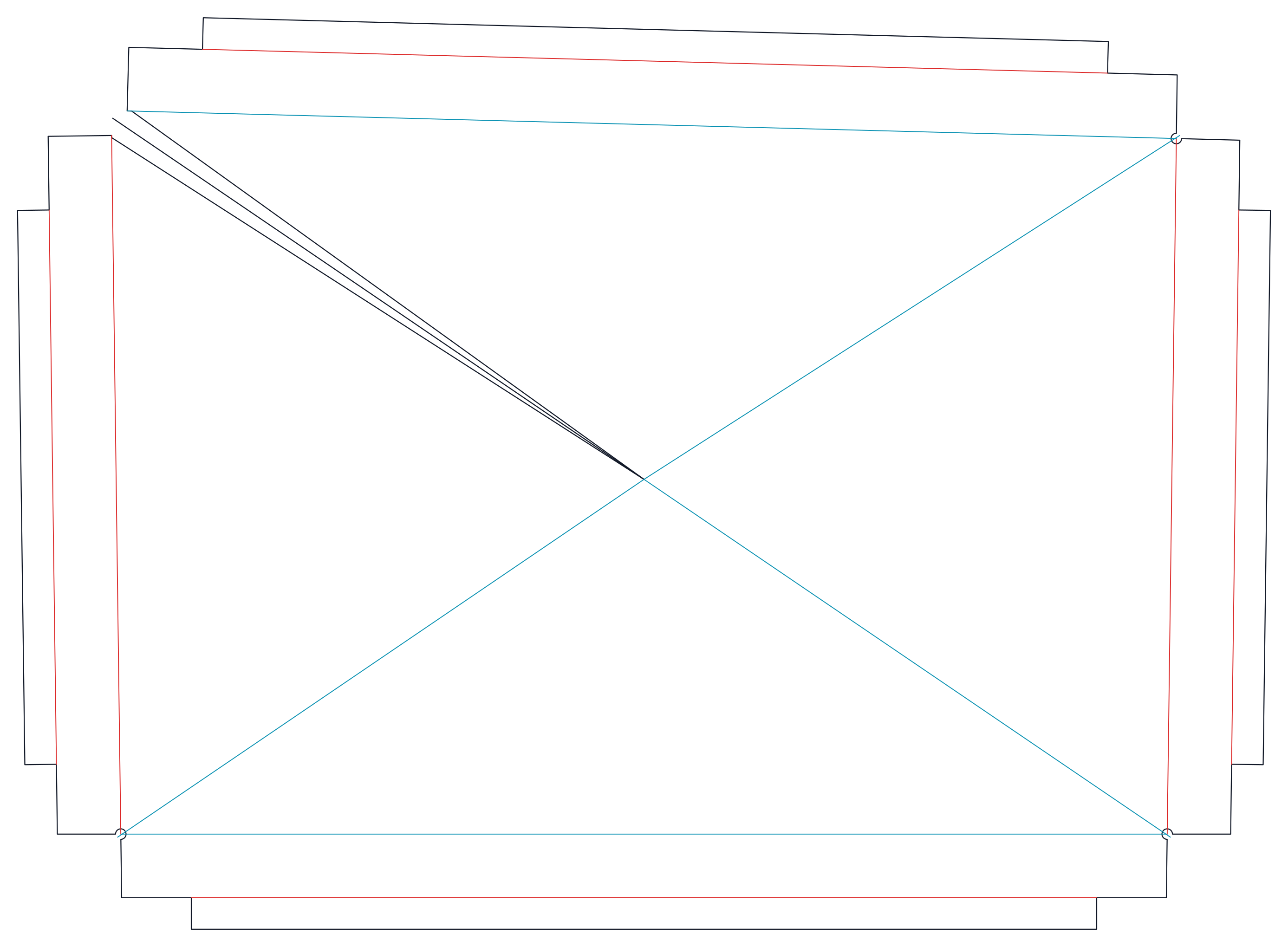
The slit is cut along its axis
Near the apex the slit is narrower than the contour tool (Ø 6 mm by default). The compensated contour cannot enter: material would remain and the panel would not fold. So the tool runs along the slit axis, end to end, and bites each facet by (Ø − V) / 2 wherever the V is narrower than the tool. On the default diamond cassette, slit s3-4 is narrower than the tool over 114 mm and the bite reaches 3.0 mm at the vertex. The SEAM_OVERCUT diagnostic says so; a thinner tool reduces the bite.
In the DXF this cut is an open polyline on the CONTOUR layer (reading the DXF). It is extended by the tool radius plus 0.5 mm past the open end so the tool exits the material, and stops dead on the apex, where its radius acts as a relief hole.
Facet folds: open V, no deduction
Facet-to-facet folds are a few degrees. On the default diamond cassette the three folds p0-4, p1-4, p2-4 are 13.6°. No cutter closes that angle exactly: the engine takes the smallest cutter whose apex angle exceeds the requirement — the 160° cutter (20° apex) — and leaves the V open by 6.4°. The angle is held by the relief geometry, not by the groove. That is the GROOVE_LEFT_OPEN diagnostic: information, not an error.
These folds get no rigid deduction: the fan of sub-trees around the vertex would each shift in its own direction and never rejoin. Their deduction is under a millimetre; the workshop does not count it. The engine reports it (DEDUCTION_SKIPPED_APEX) and machines the facets at design size. Returns and tabs keep their full deduction.
Vertical returns on a sloped facet
Since 15 September 2026, relief cassette returns are vertical: perpendicular to the wall, going down to the tab plane at −D below the base, all tabs flat in that plane for rail mounting. The facet-to-return fold is therefore 90° − slope of the facet. On the default diamond cassette: 78.7° on the long sides (slope 11.3°), 82.4° on the short sides (slope 7.6°). The engine grooves them with the 100° cutter (80° apex, V open by 1.3°) and the 90° cutter (V open by 7.6°). The return is held by the riveted tab.
On a facet descending towards the edge (the low side of a single slope), the fold exceeds 90°: it needs the 60° cutter (120° apex) or the machine profile’s overfold tolerance, which is 0° by default. See returns, tabs and corner reliefs.
Workshop procedure
- Open the family in the studio, set dimensions, relief, return, tab.
- Read the diagnostics:
GROOVE_LEFT_OPEN,SEAM_OVERCUTandDEDUCTION_SKIPPED_APEXare expected on a relief.CUTTER_UNAVAILABLEorFACE_OVERLAPblock the export. - Check the developed size:
713.4 × 518.6 mmfor the default diamond cassette, to compare with the sheet formats (nesting). - Export the R12 DXF; groove from the back, layer by layer; cut the slit on its axis; fold the returns, then the facets, close the slit.
Families concerned: diamond cassette, ridge, star, truncated pyramid, twin diamond. The catalogue shows for each the pattern generated with default parameters.
Read next: why we wrote a generator instead of drawing every DXF.
Frequently asked questions
- Why can’t a pyramid be folded without a slit?
- Around the apex, the plane angles of the facets add up to less than 360°; a flat sheet offers exactly 360°. The surplus wedge has to be removed by a slit running from the apex to the edge. When folded, its two lips meet.
- How many slits does a panel get?
- One per raised vertex. The diamond cassette has one, the ridge two (one per ridge end), the 4-branch star five interior vertices but slits only where the angular defect is not zero.
- Is the bend deduction applied to the facets?
- No. Folds converging on a vertex receive no rigid deduction (diagnostic DEDUCTION_SKIPPED_APEX): they are a few degrees and their deduction is under a millimetre. Returns and tabs keep their full deduction.
- Which cutter for facet-to-facet folds?
- The smallest cutter whose apex angle exceeds the required angle. On the default diamond cassette, the 13.6° folds are grooved with the 160° cutter (20° apex) and the V stays open by 6.4°.