Decorative panelspro
Folded ribbon
A tall, narrow strip folded in a zigzag: triangles tipping one after another and light sliding down the whole height. Wall sculpture, column cladding or, side by side, pleated cladding. Adjustable fold count, depth and diagonal slant.
Open in the studio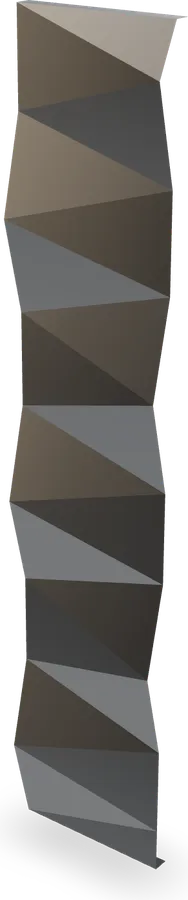
ACM 3D Studio
- Developed
- 337.7 × 1,611.5 mm
- Material
- ACM 4 mm
- Folds
- 22
- Mark
- folded-ribbon
Fabrication data
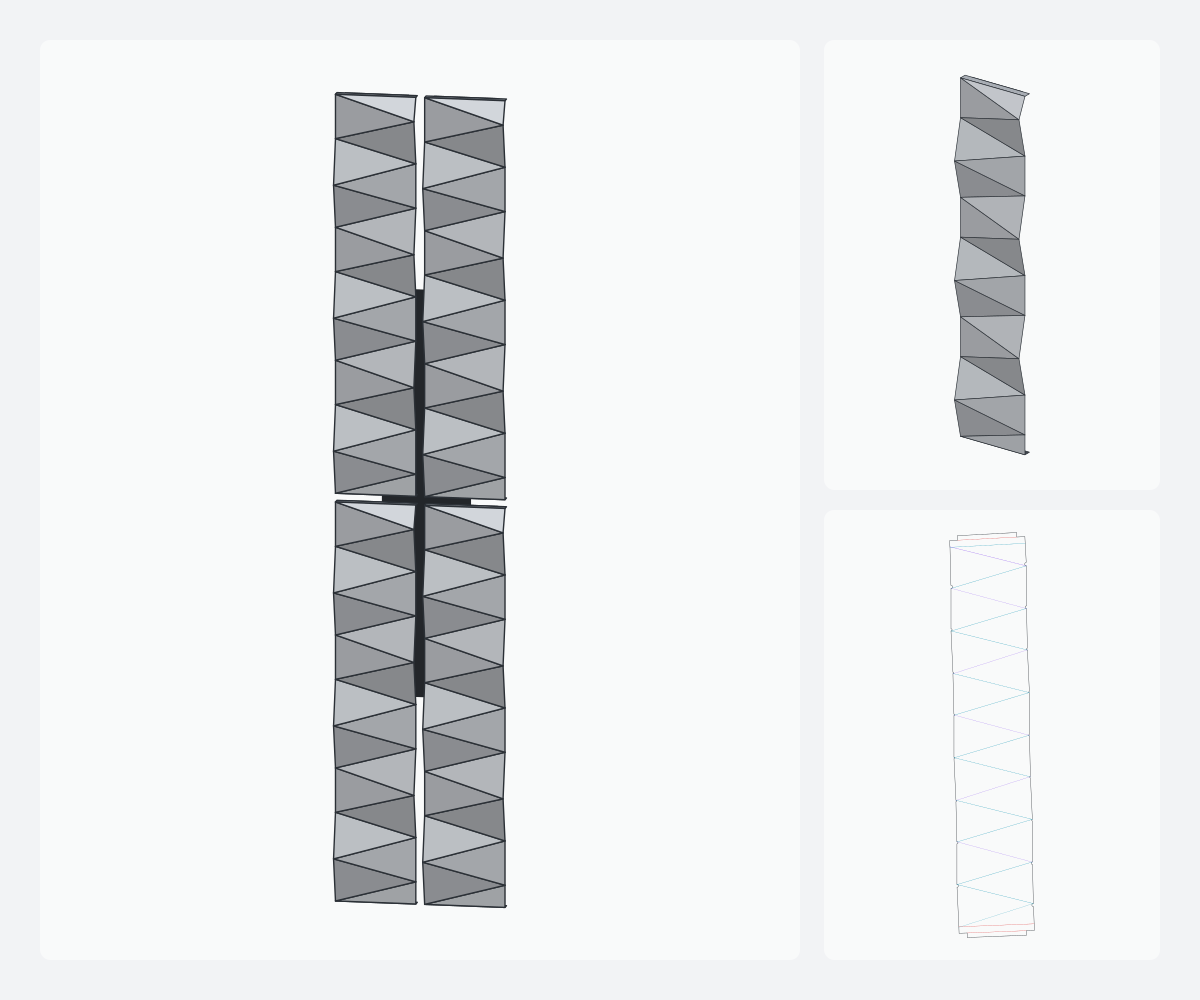
Folded ribbon — at 300 × 1,500 mm in 4 mm ACM, this family unfolds into a 337.7 × 1,611.5 mm flat pattern with 22 folds, including 1,868 mm of groove machined from the visible face, with the sheet flipped for that pass. A 1,500 × 3,200 mm sheet holds 4 of them, for 60.1 % waste.
- Material per panel
- 0.479 m²
- Folds
- 22
- Total groove length
- 6,707 mm
- Cutting length
- 3,883 mm
- Corner reliefs
- 17
V-grooves (apex angle)
- 14°3,765 mm
- 28°1,557 mm
- 90°772 mm
- 26.7°314 mm
- 64.4°300 mm
Panels per sheet
- 1,220 × 2,440 mm3(51.7 % waste)
- 1,500 × 3,200 mm4(60.1 % waste)
DXF layers
- CONTOUR3,883 mm
- RAINURE_1603,453 mm
- RAINURE_AVANT_135front face1,557 mm
- RAINURE_90772 mm
- RAINURE_135314 mm
- RAINURE_AVANT_160front face311 mm
- RAINURE_100300 mm
The names and colours your CAM software will show. RAINURE_AVANT: fold concave on the visible face, sheet flipped for that pass.
Computed by the engine at the default parameters, on 4 mm ACM and the reference router. Your own machine and material profiles change these values in the studio.
Parameters
| Parameters | Range | Default |
|---|---|---|
| Width | 200 – 3,000 mm | 300 mm |
| Height | 200 – 3,000 mm | 1,500 mm |
| Relief height | 5 – 70 mm | 40 mm |
| Rhythm | Left / right / One edge | Left / right |
| Number of folds | 3 – 21 | 9 |
| Diagonal slant | 30 – 70 % | 50 % |
| Return depth | 0 – 200 mm | 30 mm |
| Fixing tabs | — | ✓ |
| Tab width | 10 – 60 mm | 20 mm |
PresetsTotem, 9 foldsTwisting ribbonOne pleated edgeCladding plank
Manufacturing constraints
- The return must exceed the groove width plus half the bend deduction, or the groove eats into the return.
- Facet-to-facet folds are grooved with the smallest cutter of the profile, V left open: the angle is held by the geometry. The angle between two facets must not exceed that cutter’s apex angle.
- Vertical returns, all tabs flat in the −D plane (rail mounting). The facet-to-return fold is 90° ± slope: below 90°, the 90° cutter is left open and the return is held by the riveted tab; above 90° (facet descending towards the edge), a wider cutter (60° nominal = 120° apex) or the machine profile’s overfold tolerance is needed.
- Every raised vertex requires a V-slit to the edge (a flat sheet has 360°, the relief less). Near the vertex the slit is narrower than the contour tool: it is cut along its axis and the tool bites each facet by up to Ø/2.
- Tabs are shortened at every corner and every kink of the edge so they never collide behind the panel: by (return + 2 mm), and more on a sharp corner, where the bisector must be cleared (tab width ÷ tan(angle/2)). An edge too short gets no tab.
- All the ribbon’s vertices lie on its two long edges: it has no interior vertex, hence no slit, and every facet is a triangle, always flat. Folds alternate ridge and valley: valleys go on the RAINURE_AVANT_* layer, machined face up.
- The fold count follows the rhythm: a multiple of 3 for left / right, an even number for one edge. Otherwise the last motif is incomplete and two neighbouring triangles fall in the same plane — a zero fold, which cannot be folded.
- Depth stays under 50 % of the fold pitch (ribbon height ÷ fold count). Beyond, triangles stand so upright that neighbours overlap in the pattern and folds call for a sharper cutter than the workshop has.