Façade cassettespro
Sunburst fan cassette
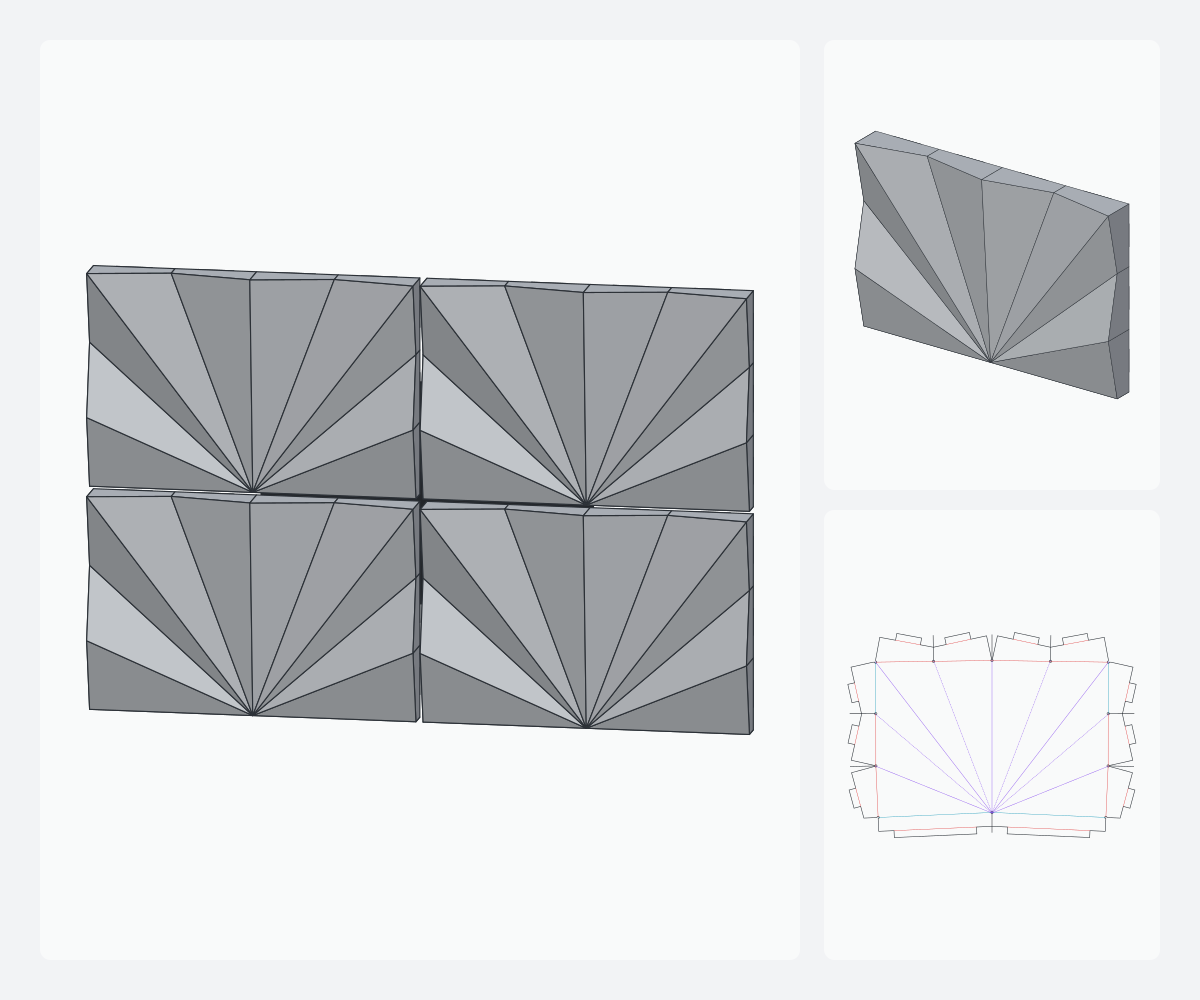
The pleats start from the middle of one edge and radiate to the three other sides: a rising sun in relief. Straight origin edge, three zigzag edges, adjustable ray count and height.
Open in the studio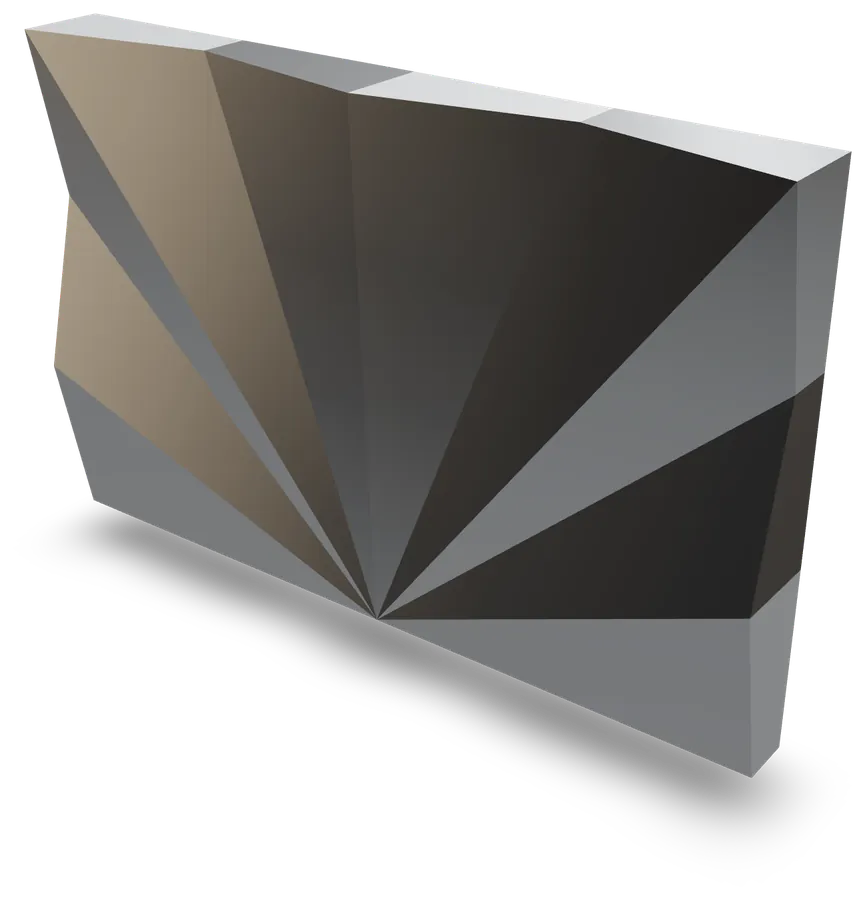
ACM 3D Studio
- Developed
- 754.1 × 536.2 mm
- Material
- ACM 4 mm
- Folds
- 33
- Mark
- fan-sunburst
Fabrication data
Sunburst fan cassette — at 600 × 400 mm in 4 mm ACM, this family unfolds into a 754.1 × 536.2 mm flat pattern with 33 folds, including 1,657 mm of groove machined from the visible face, with the sheet flipped for that pass. A 1,500 × 3,200 mm sheet holds 8 of them, for 41.3 % waste.
- Material per panel
- 0.352 m²
- Folds
- 33
- Total groove length
- 6,729 mm
- Cutting length
- 3,836 mm
- Corner slits
- 8
- Corner reliefs
- 12
V-grooves (apex angle)
- 90°1,262 mm
- 28°1,002 mm
- 24.1°854 mm
- 33.5°803 mm
- 27.5°659 mm
- 77.3°596 mm
- …
Panels per sheet
- 1,220 × 2,440 mm6(29 % waste)
- 1,500 × 3,200 mm8(41.3 % waste)
DXF layers
- CONTOUR3,836 mm
- RAINURE_1352,062 mm
- RAINURE_AVANT_135front face1,657 mm
- RAINURE_901,564 mm
- RAINURE_100866 mm
- RAINURE_60579 mm
The names and colours your CAM software will show. RAINURE_AVANT: fold concave on the visible face, sheet flipped for that pass.
Computed by the engine at the default parameters, on 4 mm ACM and the reference router. Your own machine and material profiles change these values in the studio.
Parameters
| Parameters | Range | Default |
|---|---|---|
| Width | 200 – 3,000 mm | 600 mm |
| Height | 200 – 3,000 mm | 400 mm |
| Relief height | 5 – 150 mm | 30 mm |
| Ray pairs | 2 – 6 | 5 |
| Origin edge | Bottom / Top | Bottom |
| Return depth | 0 – 200 mm | 40 mm |
| Fixing tabs | — | ✓ |
| Tab width | 10 – 60 mm | 20 mm |
PresetsRising sun, 10 raysFrom the top6 deep rays
Manufacturing constraints
- The return must exceed the groove width plus half the bend deduction, or the groove eats into the return.
- Facet-to-facet folds are grooved with the smallest cutter of the profile, V left open: the angle is held by the geometry. The angle between two facets must not exceed that cutter’s apex angle.
- Vertical returns, all tabs flat in the −D plane (rail mounting). The facet-to-return fold is 90° ± slope: below 90°, the 90° cutter is left open and the return is held by the riveted tab; above 90° (facet descending towards the edge), a wider cutter (60° nominal = 120° apex) or the machine profile’s overfold tolerance is needed.
- Every raised vertex requires a V-slit to the edge (a flat sheet has 360°, the relief less). Near the vertex the slit is narrower than the contour tool: it is cut along its axis and the tool bites each facet by up to Ø/2.
- Tabs are shortened at every corner and every kink of the edge so they never collide behind the panel: by (return + 2 mm), and more on a sharp corner, where the bisector must be cleared (tab width ÷ tan(angle/2)). An edge too short gets no tab.
- The origin of the rays is on the outline, at the middle of the edge: it is not an interior vertex, so there is no saddle limit and every ray can take the full set height. Both corners of the opposite edge are always fold points, so the outline stays a rectangle.