Logfive-new-families
Five new families: twin diamond, chevron, eight facets, hexagonal plateau, mansard pyramid
Families 35 to 39 join the catalogue. What each one does, how many slits it needs, and why the stepped pyramid with a flat landing we wanted at first will never exist: its corners are saddles.
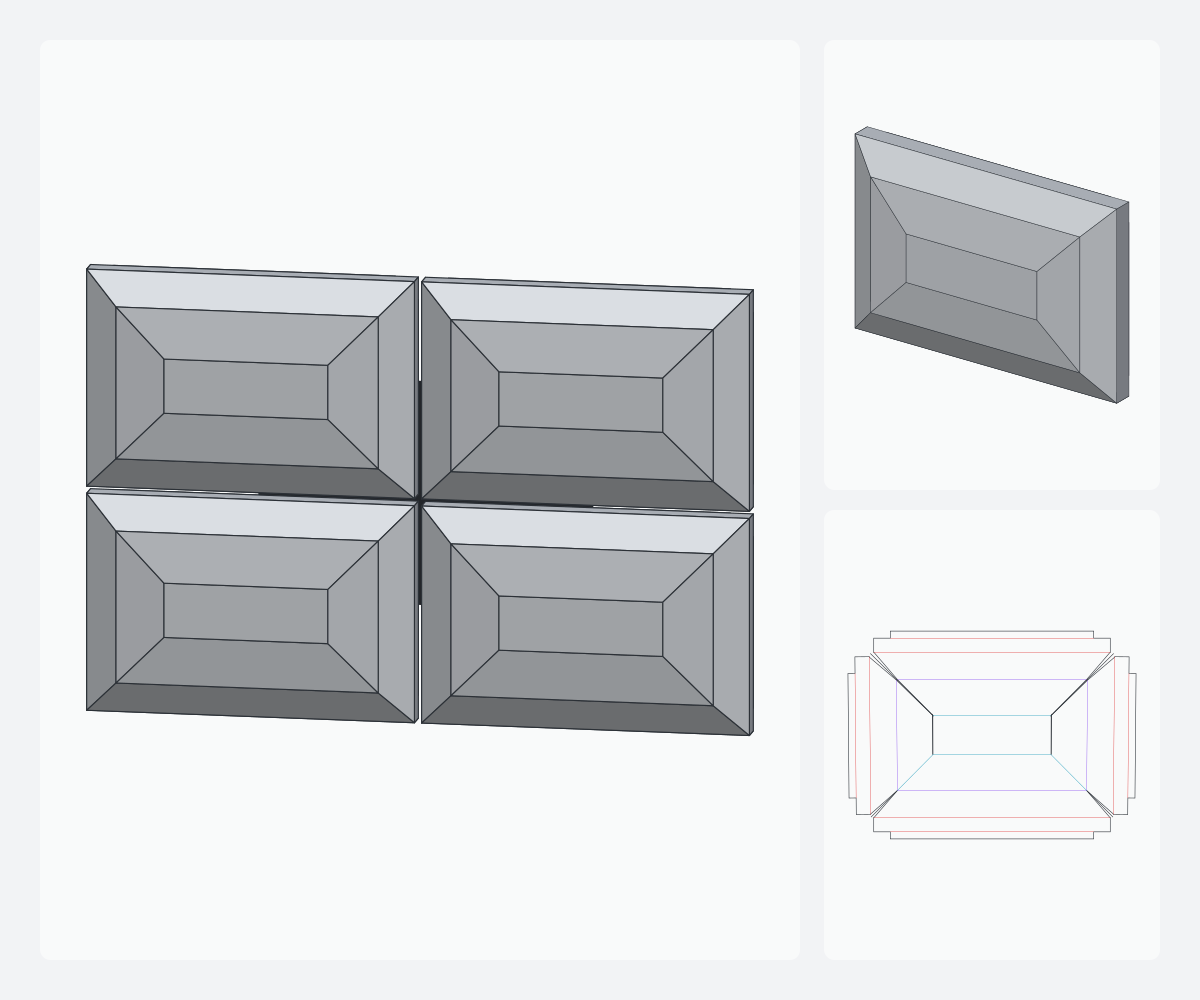
Five relief families entered the catalogue this week, all built by the same reliefCassette() constructor: a family only provides its mesh, the engine does the rest — spanning tree, seams at raised vertices, returns perpendicular to their facet, tabs. Here is what each one does, and what we learnt while drawing them.
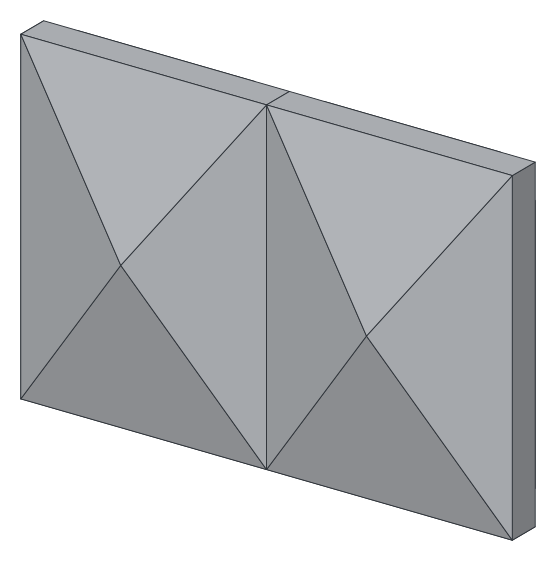
Twin diamond (35)
Two or three pyramids side by side on a single twin diamond cassette. Each cell has its apex, hence its slit, towards the top or bottom edge. Neighbouring cells meet on a valley at base level: a re-entrant fold, grooved from the visible face, on the RAINURE_AVANT_<n> layer. The apex height is adjustable (40 mm by default), so is its vertical position, and the zigzag option alternates up / down from one cell to the next: at wall scale the pattern becomes a broken line. One part, one mounting, where we used to make two cassettes and a joint.
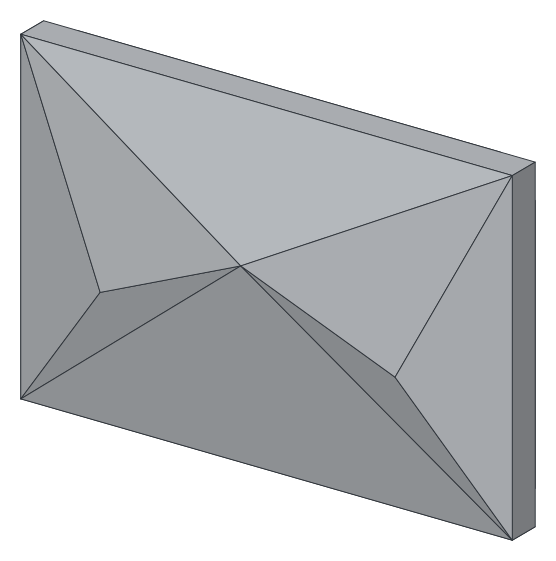
Chevron (36)
A ridge broken into a V: a central peak and two ridge ends a little lower, joined to the four corners by eight triangular facets. Three raised vertices, hence three slits. The constraint the engine imposed on us: the ends must stay above the plane of their peak and their two corners, otherwise they are saddles. Their height is bounded accordingly, and the chevron cassette refuses the rest rather than drawing it.
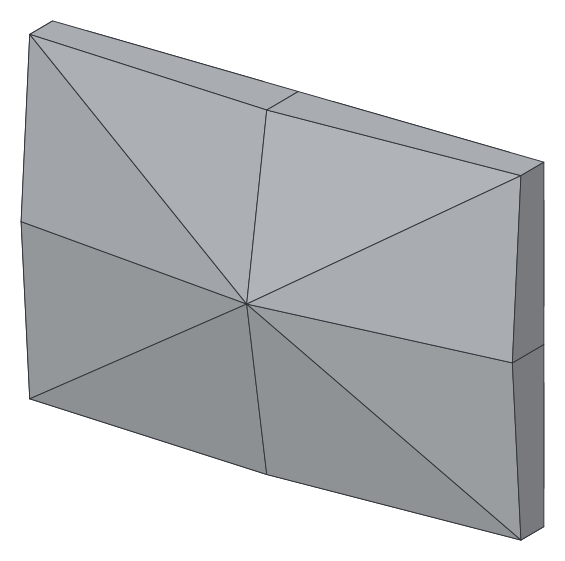
Eight-facet pyramid (37)
The central apex is joined to the four corners and to a raised point on each edge: eight triangular facets. We first put that edge point at base level — and the engine created no fold at all, because the two triangles stayed in the same plane. It has to be lifted; the edge then becomes a zigzag and each side carries two trapezoidal returns, like the fan. The eight-facet pyramid lets you offset the apex (25 to 75 % in X and Y) and move the edge points.
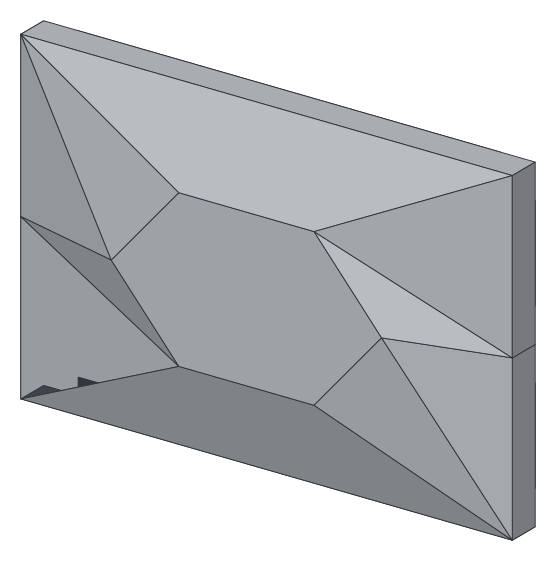
Hexagonal plateau (38)
A raised hexagonal plateau at the centre of a rectangular base. The flank joining the six plateau edges to the borders is made of two trapezoids (top and bottom, parallel edges) and eight triangles; the six plateau corners are raised vertices, six slits towards the edges. 35 mm relief by default, plateau from 30 to 80 % of the cassette. The hexagonal plateau cassette has the most seams in the catalogue.
Mansard pyramid (39) — and the stepped pyramid that will not exist
What we wanted at first was a stepped pyramid: a slope, a flat landing, a second slope, a plateau. The mesh takes ten minutes to draw. The engine refused it with a VERTEX_NOT_DEVELOPABLE on the four inner corners of the landing. We first suspected a bug.
It was not one. Around a vertex, a flat sheet offers exactly 360°. If the facets meeting there add up to less, a wedge of material is removed: that is a slit, and it closes when folding. If they add up to more, material would have to be added — no flat sheet gives that; it is a saddle. At the outer corner of the landing (steep slope, then flat), the sum is under 360°: convex, one slit, all is well. But at the inner corner, where the flat landing meets the second steep slope, the two landing trapezoids bring 135° each and the two slope trapezoids above about 49°: 368°. A saddle. The arithmetic is the same for “gentle slope then steep slope”.
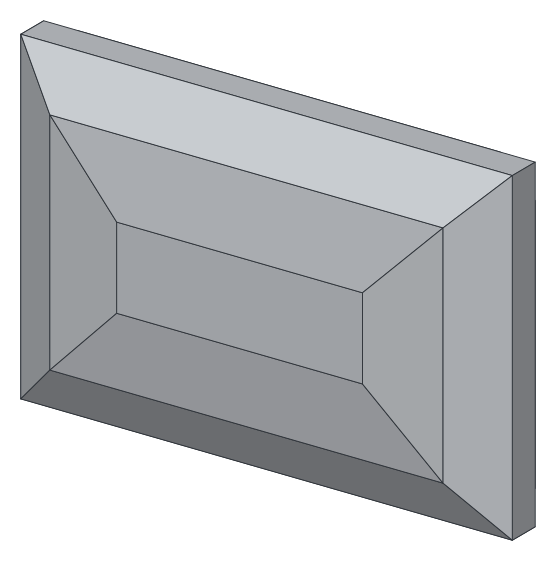
The mansard pyramid is the version that holds: a steep slope from the edge, a break, then a gentle slope up to the plateau — the profile of a Mansart roof. The break edge is then salient, and its four corners are raised vertices like those of the plateau: eight short slits, all at corners. The rule guaranteeing convexity lives in the family: the lower slope must be at least 1.25 times steeper than the upper one. Ask for more height on the gentle slope and the engine brings it back and tells you (PARAM_ADJUSTED). Defaults: 60 mm of steep slope over 35 mm of height, 90 mm of gentle slope over 12 mm, minimum plateau 60 mm.
Read next: unfolding a relief cassette, facet by facet.